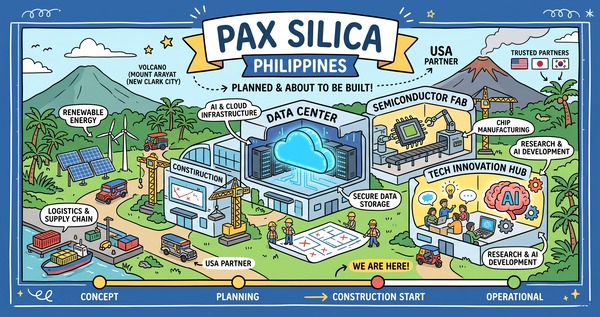
To every Filipino worried about Pax Silica: you’re right to worry. But you’re worrying about the wrong thing.
The water problem is real. The energy problem is real. The pollution, the garbage, the displacement of indigenous communities, the lack of good jobs, the brain drain. All of it is real. These are urgent, painful, daily problems that affect millions of Filipino families.
But here’s the thing nobody in power wants to say out loud, and nobody in the opposition wants to admit: every single one of those problems exists right now. Today. Without Pax Silica. They existed yesterday. They existed five years ago. They will exist five years from now if nothing changes.
Forty million Filipinos have no access to safe drinking water. The country’s groundwater-stressed areas have nearly tripled in twenty-five years. The Philippines has some of the highest electricity prices in all of Asia. Over half the population lacks access to safe drinking water according to international assessments. The Malampaya gas fields that supply a huge share of Luzon’s energy are running dry. Filipino engineers and scientists graduate, leave the country, and never come back because there are no jobs worthy of their skills.
These are not Pax Silica problems. These are Philippine problems. And the question every Filipino should be asking is not “should we stop Pax Silica?” but “why haven’t these problems been fixed already, and can Pax Silica finally be the reason they get fixed?”
What other countries did when they were in our position
The Philippines is not the first poor country to face this kind of crossroads. Other nations stood in the same spot, with the same doubts, the same fears, and the same broken infrastructure. The ones that said yes, with conditions, changed the lives of their people forever.
South Korea was poorer than the Philippines. After the Korean War ended in 1953, South Korea was one of the poorest countries on the planet. Its per capita income was lower than many countries in sub-Saharan Africa. Infrastructure was destroyed. The population had nothing. In the 1970s, Korean companies were seen globally as makers of cheap, low-quality goods. Nobody took them seriously.
Then the Korean government made a bet on semiconductors and electronics. Companies like Samsung, which started as a small grocery trading shop, were pushed into high-tech manufacturing. It wasn’t easy and it wasn’t perfect. There was corruption, there were growing pains, there was criticism from all sides. But by the 1990s, South Korea had become a global semiconductor powerhouse. Samsung alone now contributes more than 22% of South Korea’s entire GDP. The country went from devastating poverty to becoming Asia’s fourth-largest economy.
The transformation wasn’t magic. It was a decision to take the opportunity and negotiate it into something that worked for Korean people.
Taiwan was a backwater. In the 1970s, Taiwan was doing the same thing the Philippines does today: low-end assembly work for American and Japanese semiconductor companies. The cheap labor, the low-skill jobs, the assembly lines where someone else owned all the technology and all the profits. Sound familiar?
Then in 1987, a company called TSMC was founded, and Taiwan chose to become a semiconductor manufacturer rather than just a semiconductor assembler. Today, TSMC alone produces over 90% of the world’s most advanced chips. Semiconductors account for more than 20% of Taiwan’s GDP. The company employs hundreds of thousands of people in high-paying engineering and research jobs. Taiwan went from a place where chips were packaged to a place where chips are designed and built, and it transformed the entire economy.
Penang, Malaysia, started exactly where we are. In the 1970s, Penang began as a modest outsourced semiconductor assembly and test hub, the same bottom-of-the-ladder position the Philippines has been stuck in for fifty years. American and Japanese companies set up factories there for cheap labor.
But over five decades, Penang evolved. It attracted over 350 multinational corporations and grew more than 6,500 manufacturing-related small and medium businesses. Local engineers who started as factory floor workers eventually became entrepreneurs who founded their own companies, companies that are now internationally recognized in automated testing, precision engineering, and semiconductor services. Penang went from “Made in Malaysia” to “Made by Malaysia.” The state’s share of Malaysia’s manufacturing output doubled in a single decade.
Malaysia is now one of the world’s top six semiconductor exporters, and its semiconductor industry contributes roughly 25% of national GDP.
These aren’t fairy tales. These are countries that were just like us. What they did differently is they grabbed the opportunity and demanded that it work for their people. What the Philippines has been doing for fifty years is the same assembly, testing, and packaging work, while everyone else moved up.
Your concerns are valid. They also have solutions.
This is not about dismissing the critics. The concerns being raised about Pax Silica are legitimate. But they have known, proven, real-world solutions. Other countries have already faced these exact problems and solved them. The technology exists. The engineering exists. The expertise exists. What’s been missing in the Philippines is the funding and the political will to implement them.
Water. Yes, semiconductor manufacturing uses a lot of water. This is a real issue in a country where forty million people still can’t get safe drinking water. But here’s what the critics rarely mention: the semiconductor industry has already solved this problem elsewhere.
TSMC, the world’s largest chipmaker, operates in Taiwan, an island that suffers from severe droughts. TSMC built the world’s first industrial reclaimed water plant dedicated to advanced semiconductor processes. Its water recycling systems reuse each drop of water 3.5 times on average. At its Arizona facility in the United States, in the middle of a desert, TSMC built a 15-acre water reclamation plant designed to reuse nearly every drop of water, with a target recycling rate of 90%. At startup, 65% of the water used in Arizona operations comes from TSMC’s own in-house recycling systems.
TSMC received the Alliance for Water Stewardship’s highest “Platinum” certification, the first semiconductor company in the world to do so. In its Tainan facilities, reclaimed water reduced city-water usage by 31%.
This technology isn’t experimental. It’s operational. It works right now, at scale, in drought-prone environments far more water-stressed than Central Luzon.
The real question isn’t whether semiconductor manufacturing can be done without destroying local water supplies. It can. The real question is why, after decades of government promises, forty million Filipinos still don’t have clean water, and whether Pax Silica’s arrival, with its requirement for world-class water infrastructure, might finally force that problem to get fixed.
Energy. The Philippines already has an energy crisis. The president has declared a state of emergency over energy shortages. Petrol stations are closing. Electricity prices are among the highest in Asia. Over 85% of the country’s primary energy comes from imported oil, gas, and coal. Wind and solar make up less than 2% of generation despite the Philippines having some of the best renewable energy potential in the region.
This crisis has nothing to do with Pax Silica. It’s been building for years because of underinvestment in new generation capacity and overdependence on imported fossil fuels. The Malampaya gas fields are running dry. The grid hasn’t been modernized.
What Pax Silica does is create a reason, and a funding source, to finally build new energy infrastructure. Semiconductor facilities cannot operate on an unreliable grid. They need dedicated, stable power. That means new renewable energy installations, new transmission infrastructure, and potentially standalone power systems that don’t pull from the existing grid at all. That’s not a drain on the current system. That’s new infrastructure that wouldn’t exist otherwise.
Every semiconductor hub in the world has driven investment in local energy infrastructure because the factories demand it. The Philippines needs that energy infrastructure whether Pax Silica comes or not. With Pax Silica, there’s money and incentive to build it. Without Pax Silica, there’s just the same underfunded promises.
Pollution and waste. Semiconductor manufacturing does produce hazardous waste. Wastewater can contain heavy metals, solvents, and toxic chemicals. This is a legitimate environmental concern.
But again, the solutions exist and are already in use. TSMC operates one of the world’s most advanced wastewater classification and treatment systems, with 38 separate distribution systems based on the composition and concentration of different waste streams. It has developed zero-liquid-discharge technology that prevents concentrated wastewater from leaving its facilities. Intel, in Arizona, built a $44.6 million reclaimed water facility jointly with the city of Chandler that benefits both the company and the surrounding community.
Meanwhile, what’s happening with pollution in the Philippines right now, without Pax Silica? Rivers are polluted. Garbage isn’t being collected or processed properly. Industrial waste from existing factories goes unregulated in many areas. The country already has a pollution crisis that nobody is fixing because there’s no money or pressure to fix it.
Pax Silica companies, especially the kind of trillion-dollar firms that have expressed interest, operate under intense international scrutiny. They have environmental compliance standards that are higher than anything currently being enforced in the Philippines. Demanding that these standards be built into the Pax Silica agreement isn’t naive. It’s exactly what other countries have done, and it’s worked.
Indigenous displacement. This is the concern that should matter most to every Filipino, because it’s about protecting the most vulnerable people in the country. And it needs to be taken seriously.
But it also needs to be put in context. Indigenous communities in the Philippines have been displaced and marginalized for decades. By mining companies, by land conversion for agriculture and real estate, by infrastructure projects, by neglect. This isn’t a new problem that Pax Silica is creating. It’s an old wound that keeps getting reopened because Philippine law protecting indigenous rights is poorly enforced.
The answer isn’t to block economic development. It’s to finally, for once, enforce the protections that indigenous communities are legally entitled to. Demand real consultations. Demand fair compensation. Demand that ancestral domain titles be respected and that alternative livelihoods be provided. Use the international attention around Pax Silica, and the fact that global investors face reputational pressure on indigenous rights, as leverage to get something that Filipino indigenous communities have never gotten from their own government: actual protection.
Stopping Pax Silica doesn’t save indigenous communities. It just means they continue to be neglected in silence, without even the international spotlight that might force accountability.
Brain drain and lack of skilled workers. The Philippines produces world-class engineers, scientists, and IT professionals. And then they leave. They go to Singapore, the United States, Japan, the Middle East, anywhere that offers jobs matching their skills and training. The country spends money educating them and gets nothing in return.
This has been happening for decades, and it’s not because of Pax Silica. It’s because there are no high-value jobs waiting for these graduates at home. The Philippines has been stuck doing assembly and packaging, work that doesn’t need advanced engineering degrees.
South Korea solved this by building an ecosystem where engineers had work. Taiwan solved it by creating companies that needed researchers and designers, not just assembly line workers. Penang solved it by nurturing local entrepreneurs who grew out of the multinational companies that set up there.
Pax Silica, if it works as designed, would create exactly the kind of jobs that currently don’t exist in the Philippines. The kind that give Filipino engineers and scientists a reason to stay. Not call center jobs. Not garment factory jobs. Semiconductor design. AI development. Advanced manufacturing. Research.
You can’t reverse the brain drain by asking engineers to stay out of patriotism. You reverse it by giving them something to stay for.
The real problem was never Pax Silica
Let’s be honest about something. The water crisis, the energy shortages, the pollution, the displacement of indigenous communities, the brain drain, the joblessness. None of these are caused by Pax Silica. They are caused by decades of poor governance, underinvestment, corruption, and a lack of accountability in Philippine government.
That is the real problem. And the people who are protesting Pax Silica are right to be angry. They’re just aiming their anger at the wrong target.
The government hasn’t built enough water infrastructure. The government hasn’t invested in renewable energy. The government hasn’t enforced environmental laws. The government hasn’t protected indigenous lands. The government hasn’t created conditions for high-value jobs. These are failures of governance that have nothing to do with whether a semiconductor hub gets built in Tarlac.
Blocking Pax Silica doesn’t fix any of those failures. It just removes one of the few incoming sources of pressure and funding that might force them to get addressed.
Think about it this way. When a major international project comes into a country, it brings scrutiny. Global investors, international media, partner governments, NGOs. They all pay attention. The water systems, the energy grid, the environmental protections, the treatment of indigenous communities. All of it gets examined under an international spotlight.
That spotlight is uncomfortable for politicians who have been getting away with neglect. And maybe that’s the real reason some voices in power are happy to let the opposition kill this project, because it’s easier to keep things the way they are than to be held accountable for actually fixing them.
The opportunity is real, but only if Filipinos demand accountability
Pax Silica is not a gift. It’s not a guarantee. It’s an opportunity, and opportunities can be wasted. South Korea’s transformation didn’t happen because the government was benevolent. It happened because the people demanded results. Taiwan’s success wasn’t inevitable. It was built through deliberate policy decisions and relentless pressure on both government and industry to deliver.
The Philippines should not blindly accept any deal put in front of it. Filipinos should demand transparency in every agreement. They should demand that water infrastructure be built to the same standards TSMC uses in Taiwan and Arizona, not the watered-down version that Philippine politicians might try to get away with. They should demand dedicated renewable energy generation, not vague promises about future power. They should demand enforceable technology transfer requirements, not handshake agreements. They should demand independent oversight, not government self-reporting. They should demand that indigenous communities are genuinely consulted and fairly treated, not just given token acknowledgment.
And they should hold every elected official accountable for delivering on those demands.
But they should not throw the opportunity away. Because the problems that Pax Silica’s critics are warning about, water, energy, pollution, displacement, joblessness, are problems that Filipinos are already suffering from. Right now. Today. Without Pax Silica. And without something like Pax Silica bringing in the investment, the infrastructure, and the international attention, those problems have no realistic path to getting solved.
The countries that transformed themselves, South Korea, Taiwan, Malaysia, didn’t do it by turning away foreign investment and advanced manufacturing. They did it by taking the investment and fighting like hell to make sure it worked for their own people.
That’s what Filipinos should be fighting for. Not to stop Pax Silica. But to make sure that Pax Silica, and the government responsible for managing it, actually delivers for the Filipino people, for once.
Because the real enemy was never a semiconductor factory. It was always the system that let forty million people go without clean water while politicians made speeches about progress.
South Korea’s Economic Transformation
- “From Poverty to Prosperity: South Korea’s Economic Miracle,” Seasia.co, September 2025. https://seasia.co/2025/09/07/from-poverty-to-prosperity-south-koreas-economic-miracle
- “The Economic Miracle of South Korea: From Destruction to Prosperity,” The Lexicon, February 2025. https://thelexicon.org.uk/the-economic-miracle-of-south-korea-from-destruction-to-prosperity/
- “Samsung: The Company That Built South Korea,” Pietro Masina, May 2026. https://pietromasina.substack.com/p/samsung-the-company-that-built-south
- “The Future of K-Power: What South Korea Must Do After Peaking,” Carnegie Endowment for International Peace, 2024. https://carnegieendowment.org/research/2024/08/the-future-of-k-power-what-south-korea-must-do-after-peaking
- “The Symbiotic Genesis: South Korea’s Development Plans and the Semiconductor Industry,” SAIS Review of International Affairs, December 2024. https://saisreview.sais.jhu.edu/the-symbiotic-genesis-investigating-the-intricate-relationship-between-south-koreas-development-plans-of-the-1970s-and-the-current-semiconductor-industry-policy/
Taiwan’s Semiconductor Industry
- “How Taiwan Came to Dominate the Global Chip Industry,” The Conversation, April 2026. https://theconversation.com/how-taiwan-came-to-dominate-the-global-chip-industry-276939
- “Inside Taiwan’s Semiconductor Supremacy,” EE Times Asia, April 2026. https://www.eetasia.com/inside-taiwans-semiconductor-supremacy/
- “A Short History of Semiconductor Technology in Taiwan during the 1970s and 1980s,” Taiwan Insight, May 2024. https://taiwaninsight.org/2024/05/10/a-short-history-of-semiconductor-technology-in-taiwan-during-the-1970s-and-the-1980s/
- “Taiwan’s Economy is Booming Thanks to AI. Not Everyone Sees the Benefits,” Al Jazeera, May 2026. https://www.aljazeera.com/news/2026/5/27/taiwans-economy-is-booming-thanks-to-ai-not-everyone-sees-the-benefits
Penang and Malaysia’s Semiconductor Industry
- “Penang: The Silicon Valley of the East,” SEMI. https://www.semi.org/en/sea-newsletter-penang-the-silicon-valley-of-the-east
- “Penang Strengthens Position as Regional Semiconductor Powerhouse,” Buletin Mutiara, June 2026. https://www.buletinmutiara.com/penang-strengthens-position-as-regional-semiconductor-powerhouse/
- “A Look Back at How Penang Learned to Shine Through Its Electrical and Electronics Sector,” Economic History Malaysia. https://www.ehm.my/publications/articles/a-look-back-at-how-penang-learned-to-shine-through-its-electrical-and-electronics-sector
- “Time is Ripe for Malaysia to Move Upstream into Designing Chips,” ASEAN+3 Macroeconomic Research Office (AMRO), April 2024. https://amro-asia.org/time-is-ripe-for-malaysia-to-move-upstream-into-designing-chips
- “Malaysia Semiconductors,” U.S. International Trade Administration. https://www.trade.gov/market-intelligence/malaysia-semiconductors
TSMC Water Recycling and Environmental Solutions
- “TSMC Arizona: Water Management,” TSMC. https://www.tsmc.com/static/abouttsmcaz/index.htm
- “TSMC S.T.S.P. Reclaimed Water Plant Commences Operation,” TSMC ESG Report, October 2022. https://esg.tsmc.com/en-US/articles/10
- “TSMC Breaks Ground on 15-Acre Arizona Water Reclamation Plant,” AZFamily, August 2025. https://www.azfamily.com/2025/08/27/tsmc-breaks-ground-15-acre-arizona-water-reclamation-plant/
- “TSMC Building Water Reclamation Plant,” AZBEX, September 2025. https://azbex.com/planning-development/tsmc-building-water-reclamation-plant/
- “CTCI Helps Top Chipmaker TSMC Save Water With the Industry’s First Industrial Wastewater Reclamation Plant for Chip Use,” PR Newswire, September 2022. https://www.prnewswire.com/news-releases/ctci-helps-top-chipmaker-tsmc-save-water-with-the-industrys-first-industrial-wastewater-reclamation-plant-for-chip-use-301626029.html
- “Semiconductor in Numbers: Fab Water Sources,” UltraFacility, April 2026. https://www.ultrafacilityportal.io/insights/semiconductor-in-numbers:-fab-water-sources
- “TSMC Water Reclamation Facility Phoenix: Sustainable Growth,” Technical Talent Group, September 2025. https://technicaltalentgroup.com/tsmc-water-reclamation-phoenix/
- “TSMC Water Resource Management,” TSMC ESG Report. https://esg.tsmc.com/en/focus/greenManufacturing/waterResourceManagement.html
Philippines Water Crisis
- “Deepening Water Crisis,” Philippine Daily Inquirer, March 2026. https://opinion.inquirer.net/190712/deepening-water-crisis
- “Fixing Critical PH Water System,” Philippine Daily Inquirer, November 2025. https://opinion.inquirer.net/187852/fixing-critical-ph-water-system
- “Water Pollution in the Philippines,” Water.org. https://water.org/our-impact/where-we-work/philippines/
- “The Philippines Needs ‘Power of All Sorts’ to Build Energy Security,” Fortune, August 2026. https://fortune.com/2026/08/13/prime-infra-guillaume-lucci-philippines-energy-crisis/
Philippines Energy Crisis
- “Energy Crisis in the Philippines and Thailand Shows Risks of LNG and Petroleum Over-reliance,” Energy Tracker Asia, April 2026. https://energytracker.asia/energy-crisis-in-the-philippines-and-thailand/
- “Philippines Energy Market,” U.S. International Trade Administration. https://www.trade.gov/market-intelligence/philippines-energy-market